
Introduction


picows is a high-performance Python library designed for building asyncio WebSocket clients and servers. Implemented in Cython, it offers exceptional speed and efficiency, surpassing other popular Python WebSocket libraries.
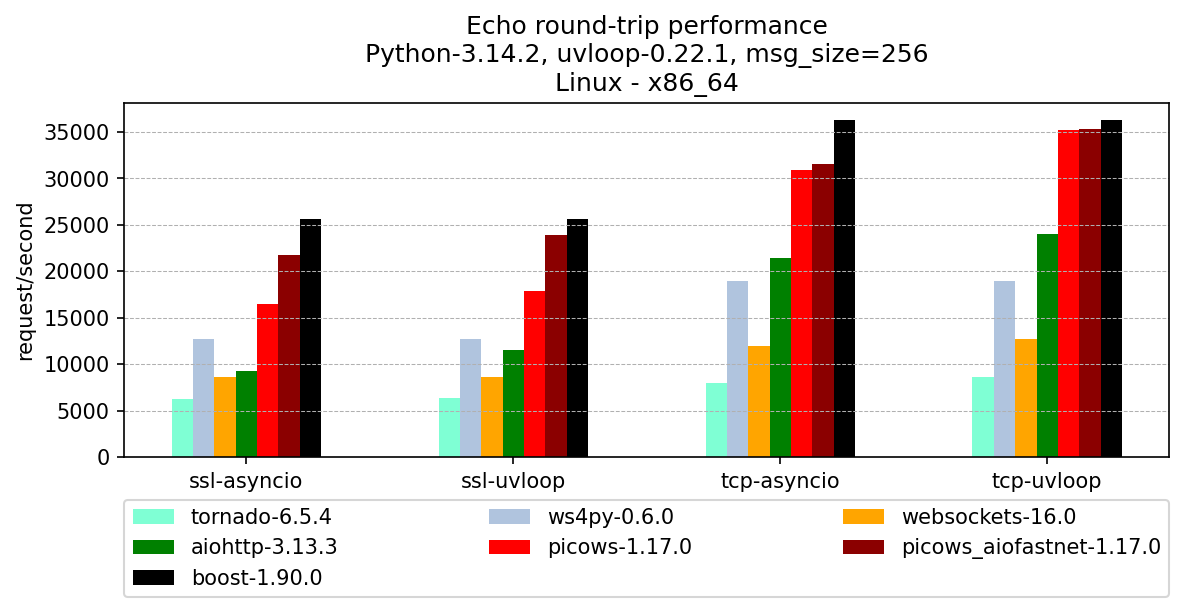
The above chart shows the performance of echo clients communicating with a server through a loopback interface using popular Python libraries. boost.beast client is also included for reference. You can find benchmark sources and more results here.
Installation
picows requires Python 3.9 or greater and is available on PyPI. Use pip to install it:
$ pip install picows
Getting started
picows provides two APIs:
A reimplementation of the popular websockets library’s asyncio interface.
A low-level core API. It is more efficient than the high-level websockets API (lower latency, higher throughput, zero-copy), but omits a few high-level features that aren’t always required.
websockets API
This is a drop-in replacement; you only need to change imports to transition from websockets to picows.
Certain features from websockets library are not supported yet. Check out websockets library compatibility for the full list.
Client
# Import picows.websockets instead of websockets
from picows.websockets.asyncio.client import connect
import asyncio


async def hello():
    async with connect("ws://localhost:8765") as websocket:
        await websocket.send("Hello world!")
        message = await websocket.recv()
        print(message)


if __name__ == "__main__":
    asyncio.run(hello())
Server
# Import picows.websockets instead of websockets
from picows.websockets.asyncio.server import serve
import asyncio


async def echo(websocket):
    async for message in websocket:
        await websocket.send(message)


async def main():
    async with serve(echo, "localhost", 8765) as server:
        await server.serve_forever()


if __name__ == "__main__":
    asyncio.run(main())
Core API
The Core API achieves superior performance by offering an efficient, non-async data path, similar to the transport/protocol design from asyncio.
The user handler receives WebSocket frame objects instead of complete messages. Since a message can span multiple frames, it is up to the user to decide the most effective strategy for concatenating them. Each frame object includes additional low-level details about the current parser state, which may help to further optimize the behavior of the user’s application.
The Core API doesn’t offer high-level features like permessage-deflate extension support or an async iterator interface for reading. These features are often not required in real-world applications, significantly slow down the data path, and make a true zero-copy interface impossible.
Client
import asyncio
from picows import ws_connect, WSFrame, WSTransport, WSListener, WSMsgType, WSCloseCode


class ClientListener(WSListener):
    def on_ws_connected(self, transport: WSTransport):
        transport.send(WSMsgType.TEXT, b"Hello world")

    def on_ws_frame(self, transport: WSTransport, frame: WSFrame):
        print(f"Echo reply: {frame.get_payload_as_ascii_text()}")
        transport.send_close(WSCloseCode.OK)
        transport.disconnect()


async def main():
    transport, client = await ws_connect(ClientListener, "ws://127.0.0.1:9001")
    await transport.wait_disconnected()


if __name__ == "__main__":
    asyncio.run(main())
Server
import asyncio
from picows import ws_create_server, WSFrame, WSTransport, WSListener, WSMsgType, WSUpgradeRequest


class ServerClientListener(WSListener):
    def on_ws_connected(self, transport: WSTransport):
        print("New client connected")

    def on_ws_frame(self, transport: WSTransport, frame: WSFrame):
        if frame.msg_type == WSMsgType.CLOSE:
            transport.send_close(frame.get_close_code(), frame.get_close_message())
            transport.disconnect()
        else:
            transport.send(frame.msg_type, frame.get_payload_as_memoryview())


async def main():
    def listener_factory(r: WSUpgradeRequest):
        # Routing can be implemented here by analyzing request content
        return ServerClientListener()

    server: asyncio.Server = await ws_create_server(listener_factory, "127.0.0.1", 9001)
    for s in server.sockets:
        print(f"Server started on {s.getsockname()}")

    await server.serve_forever()


if __name__ == "__main__":
    asyncio.run(main())