
Introduction


picows is a high-performance Python library designed for building asyncio WebSocket clients and servers. Implemented in Cython, it offers exceptional speed and efficiency, surpassing other popular Python WebSocket libraries.
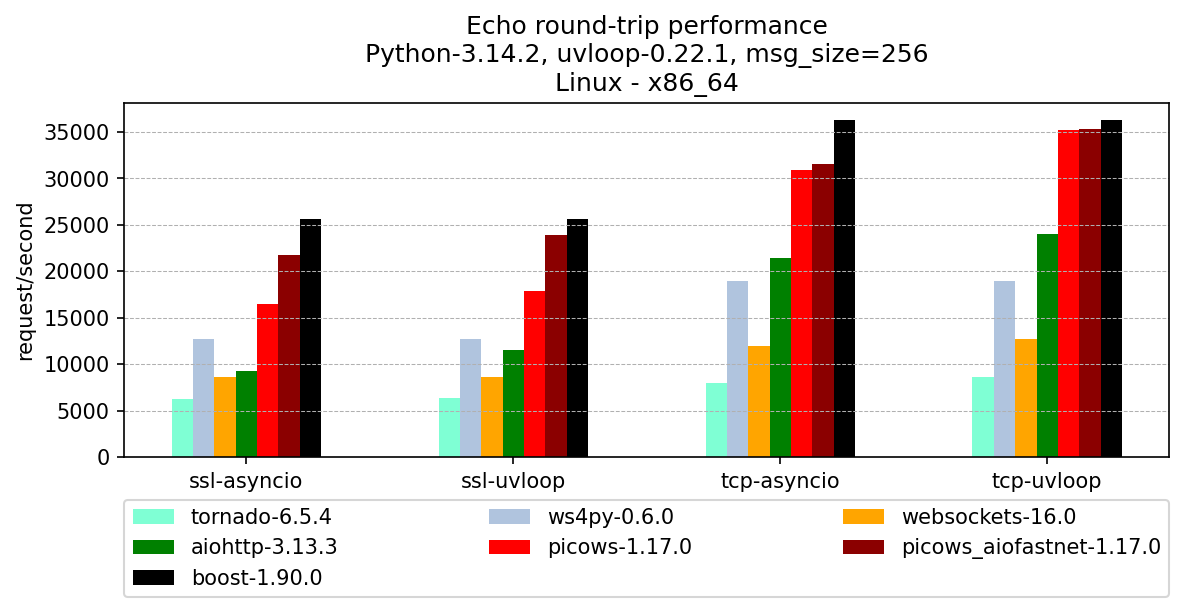
The above chart shows the performance of echo clients communicating with a server through a loopback interface using popular Python libraries. boost.beast client is also included for reference. You can find benchmark sources and more results here.
Installation
picows requires Python 3.9 or greater and is available on PyPI. Use pip to install it:
$ pip install picows
Getting started
Echo client
Connects to an echo server, sends a message, and disconnects after receiving a reply.
import asyncio
from picows import ws_connect, WSFrame, WSTransport, WSListener, WSMsgType, WSCloseCode

class ClientListener(WSListener):
    def on_ws_connected(self, transport: WSTransport):
        self.transport = transport
        transport.send(WSMsgType.TEXT, b"Hello world")

    def on_ws_frame(self, transport: WSTransport, frame: WSFrame):
        print(f"Echo reply: {frame.get_payload_as_ascii_text()}")
        transport.send_close(WSCloseCode.OK)
        transport.disconnect()

async def main(url):
    (_, client) = await ws_connect(ClientListener, url)
    await client.transport.wait_disconnected()

if __name__ == '__main__':
    asyncio.run(main("ws://127.0.0.1:9001"))
This prints:
Echo reply: Hello world
Echo server
import asyncio
from picows import ws_create_server, WSFrame, WSTransport, WSListener, WSMsgType, WSUpgradeRequest

class ServerClientListener(WSListener):
    def on_ws_connected(self, transport: WSTransport):
        print("New client connected")

    def on_ws_frame(self, transport: WSTransport, frame: WSFrame):
        if frame.msg_type == WSMsgType.PING:
            transport.send_pong(frame.get_payload_as_bytes())
        elif frame.msg_type == WSMsgType.CLOSE:
            transport.send_close(frame.get_close_code(), frame.get_close_message())
            transport.disconnect()
        else:
            transport.send(frame.msg_type, frame.get_payload_as_bytes())

async def main():
    def listener_factory(r: WSUpgradeRequest):
        # Routing can be implemented here by analyzing request content
        return ServerClientListener()

    server: asyncio.Server = await ws_create_server(listener_factory, "127.0.0.1", 9001)
    for s in server.sockets:
        print(f"Server started on {s.getsockname()}")

    await server.serve_forever()

if __name__ == '__main__':
  asyncio.run(main())